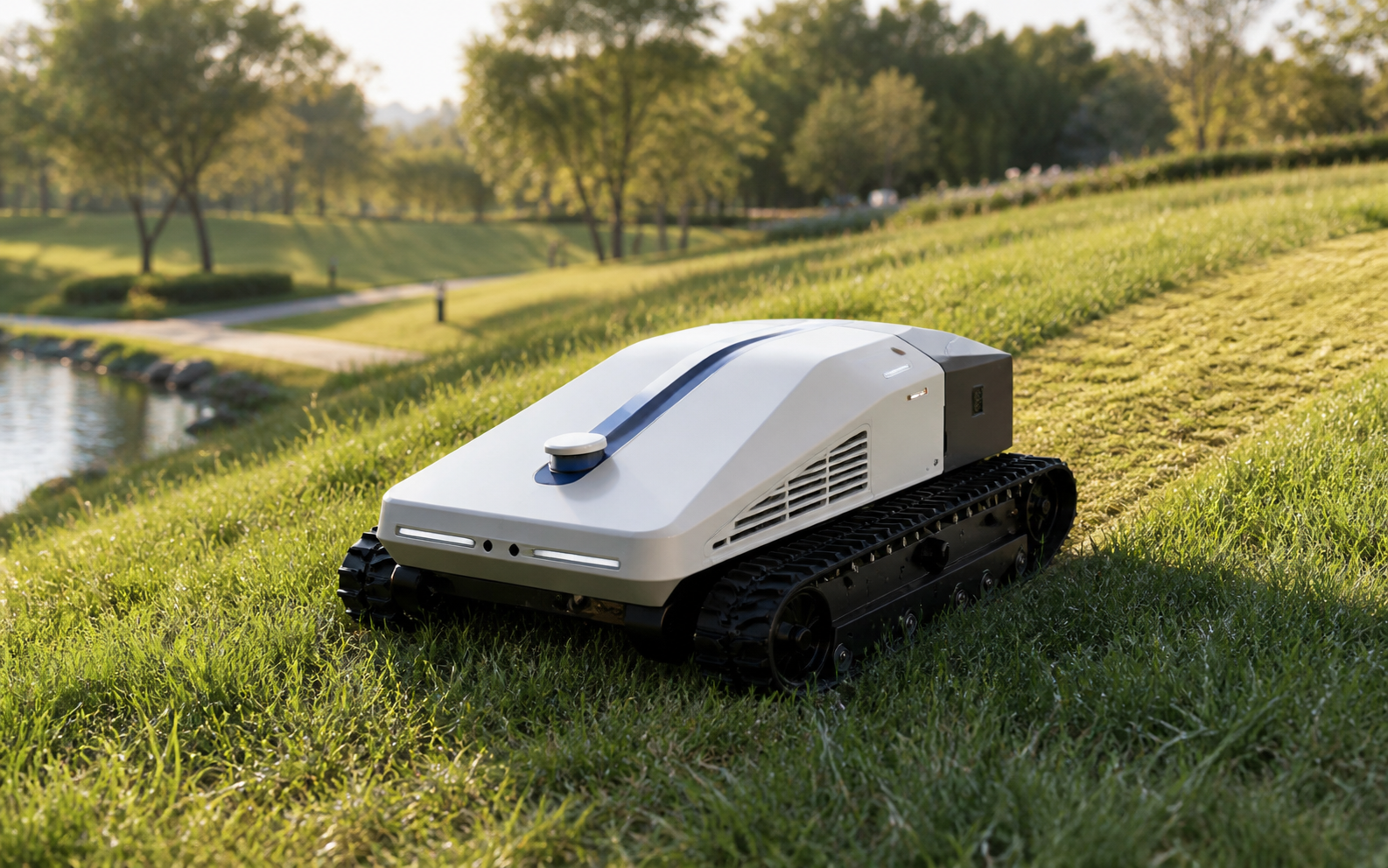
Compare electric and hybrid tracked mowers for parks, estates, orchards, embankments and rough-ground maintenance. Choose the cutting system first, then the operating and navigation configuration.
Configuration, availability and destination-market documentation are confirmed for each project.
TECHNICAL OVERVIEW
Three cutting configurations
Hybrid horizontal-blade mower
A combustion engine drives the cutting function while two electric traction motors move the tracked chassis. The material describes a 3 kW generator for the electrical system; the final battery and charging configuration must be matched to the selected build.
Electric horizontal-blade mower
A 3 kW brushless cutting motor and a 72 V / 150 Ah lithium iron phosphate battery support regular grounds maintenance. Electric traction and cutting are coordinated as separate loads.
Electric vertical/flail mower
A 1,000 mm cutting width, 5 kW working motor and 72 V / 300 Ah lithium iron phosphate battery suit rough vegetation and land-clearing tasks where the vertical-blade arrangement is appropriate.
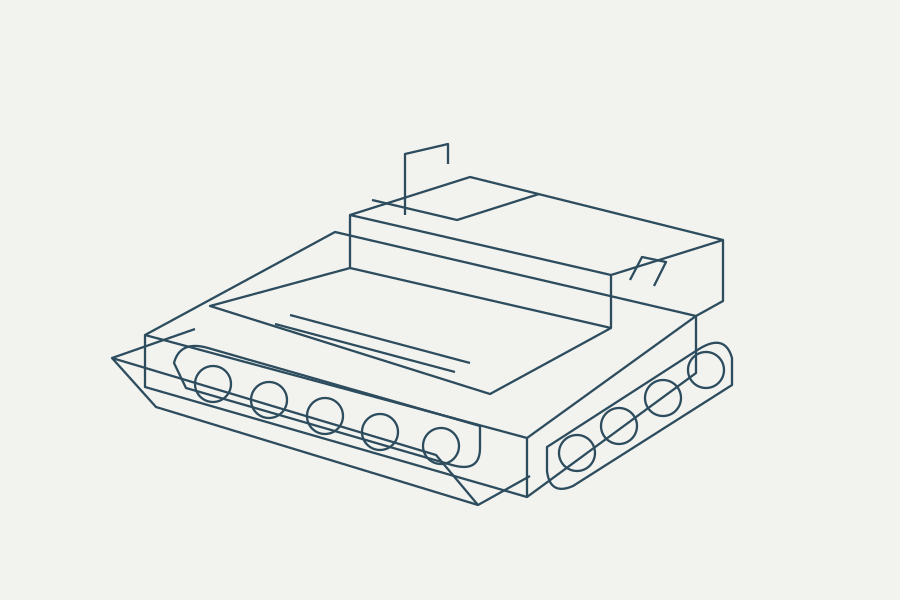
The tracked layout provides a broad ground contact area. Cutting-head selection, blade type, ground clearance and terrain limits are reviewed against the vegetation and actual work site.
Published technical reference values; final model specifications govern. Area rates were converted from 3–5 Chinese mu/hour using 1 mu = 666.67 m². Runtime, throughput and charge time depend on vegetation, terrain, duty cycle, battery condition and charger. ¹ Nominal energy is calculated as rated voltage × capacity, not usable energy. The source lists slope figures of 65 and 45 without a clear unit or test method; no slope operating limit is asserted here.
TECHNICAL OVERVIEW
Remote, assisted and autonomous operation
Remote operation / base configuration
The operator controls the machine remotely. This is the base control arrangement in the model tables; the APP and autonomous capabilities are upgrades rather than standard functions on every unit.
Precision navigation / optional
The navigation option includes straight-line guidance, extended-line cruising and automatic turning. Route geometry, position accuracy, GNSS conditions and site boundaries are part of the configuration review.
Autonomous work / optional
An APP-based autonomous-work configuration adds unattended task execution in a defined working area. The feature overview describes work-area definition, route planning and reuse of saved routes. Site commissioning and the selected perception and stop architecture determine the actual operating envelope.
Fleet visibility / connected configuration
Location, work status and fault monitoring support remote supervision. The system overview also describes track playback, remote diagnostics and OTA updates; confirm which functions are included in the selected hardware and service package.
An operator display can present machine status and alarms. Obstacle detection, lifting/cutting interlocks, communication-loss behavior, local stop controls and restart authorization should be defined for the particular site and operating mode.
TECHNICAL OVERVIEW
Powertrain and mechanical arrangement
Traction and cutting
Two 1.5 kW traction motors are listed for each configuration. Separate traction and cutting commands allow the machine designer to coordinate travel, tool operation and power demand.
Temperature and energy management
The system overview describes monitoring core-component temperatures, adjusting heat dissipation and optimizing energy allocation. These functions must be configured around the actual battery, motor controllers and engine where fitted.
Chassis and cutting hardware
The material describes an integrated welded chassis, protective coating and alloy/steel cutting components. Installed corrosion protection, washdown tolerance, blade service life and impact limits depend on the delivered build.
Transport accessory
The hybrid horizontal-blade configuration lists an optional electrohydraulic lifting transport bed with a volume of 0.33 m³. This is a volume specification; permissible payload mass and stability limits require separate confirmation.
Electrical building blocks include battery protection, traction drives, tool drive, DC-DC conversion, current monitoring, position/state feedback, sealed power and signal connections, and the machine stop interface.
Select the blade arrangement and cut-height range around maintained grass, finished surfaces, noise expectations and daily working windows.
Orchards and hillside grounds
Check row width, turning space, branches, fruit debris, ground pressure and traction. Establish site-specific slope and rollover limits before operation.
Embankments and large grounds
Review access, edges, moisture, vegetation density and operator visibility. Precision navigation can support repeatable passes where positioning remains reliable.
Rough vegetation and reclamation
The vertical/flail configuration is presented for gardens, campsites and land-clearing work. Confirm the vegetation size, allowable debris and blade specification before selecting it.
Project inputs: area and vegetation photographs; minimum access width; terrain and drainage; preferred cut height; work hours; charging access; remote or autonomous mode; monitoring needs; spare blades and service expectations.
START WITH YOUR WORKLOAD
Define your equipment project.
Tell us the task, terrain, operating schedule, quantity and delivery destination. We can review equipment configurations, electrical modules and supporting technical information together.