Review battery-electric, range-extended and plug-in hybrid architectures for farm transport, ranch work, site mobility and off-road recreation. Coordinate the vehicle package with its powertrain, control and connected-service requirements.
Configuration, availability and destination-market documentation are confirmed for each project.
TECHNICAL OVERVIEW
Select the vehicle task
Utility / farm vehicle
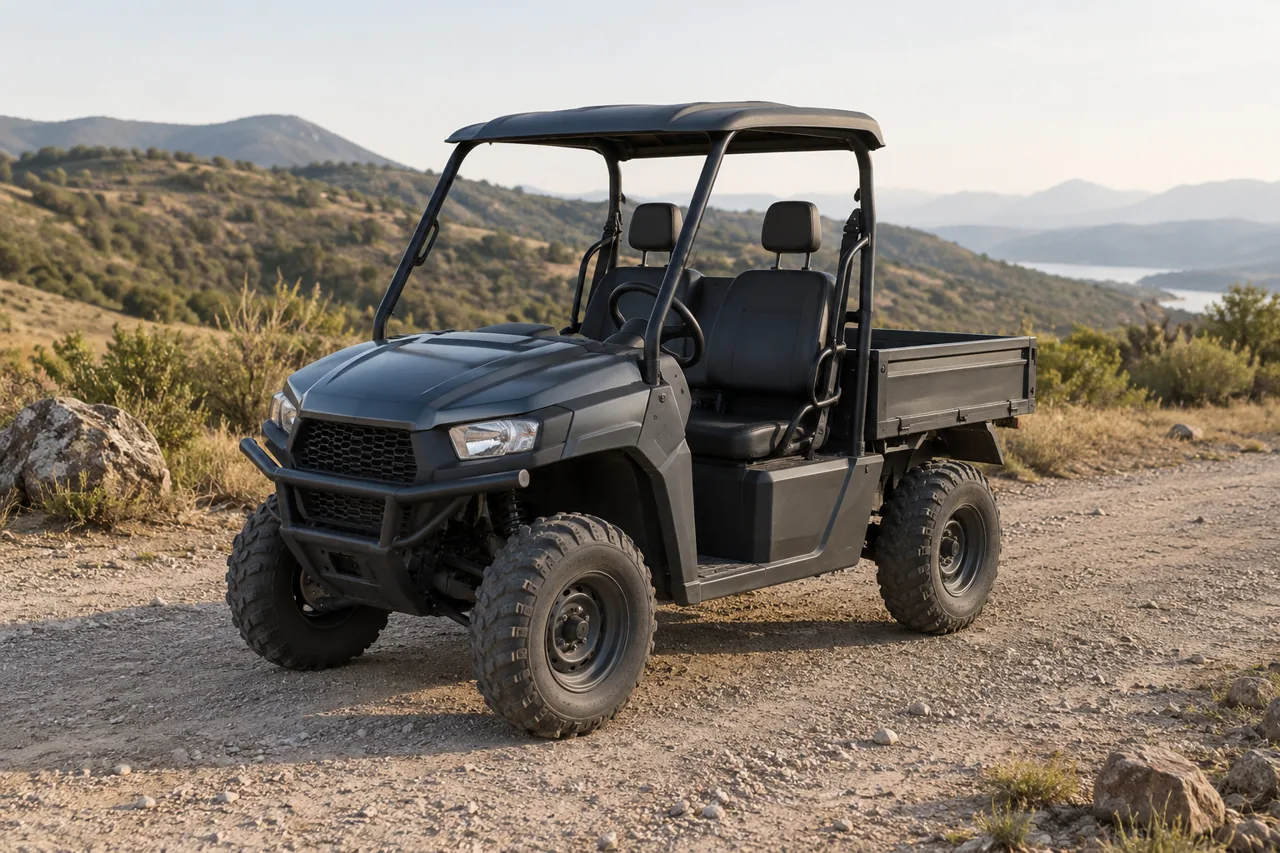
A side-by-side arrangement with steering wheel, pedals, occupant seating and a work bed supports moving tools and materials around private farms, ranches and work sites. Cargo and towing requirements drive the chassis selection.
Sport / recreation arrangement
A sport-oriented side-by-side emphasizes drive response, suspension travel and off-road handling. The selected vehicle requires its own occupant protection, braking, stability and use instructions.
Crew arrangement
The reference distinguishes multi-row configurations for approximately 3–6 occupants. Seat count, bed length, loaded weight and suspension settings are model-specific rather than interchangeable across the family.
UTVs use side-by-side seating, a steering wheel and pedal controls. They differ from handlebar-steered, straddle-seat ATVs. A roll structure, restraint system and optional doors or roof are vehicle-level configuration items; their test documentation must accompany the chosen model.
TECHNICAL OVERVIEW
Three energy architectures
Architecture
Operating principle
Reference range discussion
Suitable project questions
Battery electric / BEV
Battery supplies the traction motor(s); recharge from an external supply
150–200 km / 93–124 miles
Daily distance, pack capacity, charging access, payload and ambient temperature
Range extended / EREV
Electric traction with onboard fuel-powered generation
300+ km / 186+ miles
Fuel availability, generator duty, emissions certification and battery strategy
Plug-in hybrid / PHEV
Plug-in battery with a hybrid engine/electric drive arrangement
400+ km / 249+ miles
Drive architecture, mode transitions, fuel use, charging and emissions certification
These are reference architecture figures from the product material, not a certified range for a specific vehicle. Battery size, fuel tank, drive cycle, speed, load, terrain and test conditions were not supplied. Confirm the exact propulsion layout and measured range of the selected model.
TECHNICAL OVERVIEW
Six coordinated powertrain systems
Motor controller / MCU
A silicon-carbide power-stage approach is described, with reference conversion efficiency ≥98.5%, peak current 450 A and an IP67 protection claim. Efficiency depends on the operating point; peak-current duration and installed protection require model documentation.
Vehicle controller / VCU
Coordinates driver intent, driving modes, torque demand, energy management and OTA-capable control logic. The architecture discusses computational redundancy and response below 5 ms; these are subsystem reference values, not a complete vehicle safety certification.
Battery management / BMS
Active balancing, battery state estimation and temperature monitoring are described. Reference targets include SOC accuracy within ±2%, operation across −30 to 60 °C and more than 2,000 cycles. Cell type, usable operating window, cycle depth and acceptance criteria must be specified.
Range-extender control
Controls the generator operating strategy and coordination with the traction battery. The reference considers gasoline, diesel and methanol paths; a particular engine and fuel configuration needs its own destination-market documentation.
Four-wheel-drive torque distribution
A distributed torque-vectoring approach coordinates the driven wheels, with a subsystem response target below 10 ms. Available traction modes and behavior are tied to the actual motor, differential and controller arrangement.
Thermal management
Coordinates battery, motor and cabin thermal circuits. Cooling capacity, pump control, temperature sensors and low-temperature preparation must be sized for the duty cycle and environment.
Example performance figures in the reference include maximum power of 150 kW and peak torque of 450 N·m. They are not mapped to every propulsion variant, and continuous power, torque measurement point, gearing and test conditions were not supplied. Specify an exact build before comparing vehicle performance.
TECHNICAL OVERVIEW
From driver command to vehicle behavior
Functional block
Integration scope
Driver inputs
Pedal and direction interpretation, gear/drive-mode requests and operator display
Traction control
Torque requests, wheel-drive coordination, regeneration and enable sequencing
Energy control
Battery limits, power allocation, charge control and range-extender coordination where fitted
Auxiliary systems
Lighting, horn, body electronics, pumps, thermal circuits and accessory supplies
Network and diagnostics
CAN communications, gateway routing, fault state reporting and service access
Connected operations
Location, work logs, fault alerts, fleet supervision and controlled update workflows
A modular controller platform can be configured around the required vehicle logic. Hardware pinout, input levels, output loads, CAN database, fault reactions and verification evidence are part of the integration package.
Material hauling, tool transport and private-site travel. Define cargo volume, payload mass, towing demand, low-speed duty, dirt exposure and the charging or refueling plan.
Construction and mining sites
Crew movement and equipment support within defined work areas. Review access routes, grade, braking, loaded operation, protection and site operating rules.
Estates and outdoor facilities
Maintenance rounds, grounds support and supervised passenger movement. Establish occupancy, storage, lighting and noise requirements.
Off-road recreation
Review passenger restraints, rollover structure, suspension, trail access and the intended operating environment of the selected sport or family configuration.
The general comparison material mentions 500–800 kg or greater cargo figures for the UTV category. It does not identify a tested payload for a particular offered model; we therefore confirm bed, payload and towing limits individually.
TECHNICAL OVERVIEW
Information for a vehicle enquiry
Send the destination and intended use; seating and cargo needs; maximum speed; daily travel; grade and terrain; BEV, EREV or PHEV preference; charging supply; weather exposure; telematics and autonomy requirements; quantity; delivery schedule; and service/spares plan.
For a U.S. project, also request exact model identification, road/off-road design documentation, applicable engine/emissions records, battery transport test summary and wireless equipment information. Market entry and road use are confirmed for the chosen vehicle, separately from the reference architecture.
START WITH YOUR WORKLOAD
Define your equipment project.
Tell us the task, terrain, operating schedule, quantity and delivery destination. We can review equipment configurations, electrical modules and supporting technical information together.